
The former UK Prime Minister Boris Johnson is experiencing what multitudes of others have experienced in their life – small-time judges.
Grilled by the Commons Privileges Committee of the UK House of Commons about his possible misleading of MPs in the UK Parliament, Johnson hinted that he may refuse to accept the verdict from its inquiry if it finds that he misled Members of Parliament.
Johnson’s opening statement to the Cross-party Committee, comprising seven MPs, four Tories, two Labour and one SNP, including the Labour chairman, Harriet Harman, was a firm rebuttal of the tendentious and prejudicial opinions that had circulated in the British mainstream media and social media, which I have come to expect.
Veteran, former-MP George Galloway mocked the investigation as a kangaroo court and said that its questioning is symptomatic of the malaise in western democracies. However, Johnson himself distanced himself from the ‘kangaroo court’ charge that had been associated with himself.
Thought Police and mind-reading
Johnson’s opening statement asserted that the Committee, after ten months of investigation, had produced no evidence against him. Fraser Nelson thinks this is plausible and that there is “no smoking gun”, repeated by his colleague at The Spectator Katy Balls. Nelson thinks that in the absence of evidence it will come down to “gut feeling”, but that Johnson will survive. He agrees with Galloway that it is so trivial compared to bigger issues. As far as I could see, in the absence of evidence, the Committee had tasked itself with judging not only Johnson’s motives but his very thoughts when he addressed the House of Commons. They are engaged in mind-reading.
Objective law
Possibly this is no wonder. Examing his thoughts in the absence of evidence is much the same as the Scottish Court of Session did when Boris Johnson tried to prorogue Parliament in 2019, corrected by the UK Supreme Court. Subjective opinion is being introduced into legal judgments and it would be little wonder if it is taking over other areas of law. It is wrong. Law should be objective and decisions should be objective.
Common experience
The House of Commons Committee is no different in this respect from most employers taking their employees to task, or any other organisation taking on individuals. It is disproportionate.
Some application
“Who made Me a judge over you?” asked Jesus Lk 12:14. Yet there are plenty of small-time judges in most human affairs. Thankfully, at present Jesus is a Saviour and not yet exercising His authority as Judge Jn 5:22. At the Day of Judgment, how will you be able to stand? Who will plead for you? 1Jn 2:1.
“Prepare to meet thy God.”
Amos 4:12
Update:
9 Jun 2023: Boris Johnson has resigned as an MP after receiving a letter from the House of Commons’ Privileges Committee. In a statement he said: “Their purpose from the beginning has been to find me guilty, regardless of the facts This is the very definition of a kangaroo court. Most members of the Committee – especially the chair – had already expressed deeply prejudicial remarks about my guilt before they had ever seen the evidence. They should have recused themselves.” Professor Sked’s prediction is arriving. This is not the only example of the damaging effect of judging of motive without evidence. Johnson has persistently maintained that “I did not lie” and that he did not intend to mislead the House of Commons.
13 Jun 2023: Boris Johnson has urged the Privileges Committe to publish their report in full, to “let the world judge their nonsense”.
14 Jun 2023: the latest twist in the tail – Guido Fawkes has an exclusive tale that Bernard Jenkin the vice-chair of the Privileges Committee attended his wife’s birthday party with drinks in the House of Commons during the the coronavirus pandemic lockdown. Boris Johnson has written to the chair Harriet Harman to investigate it and Boris has called on Jenkin to resign, asserting “To borrow the language of the committee, if this is the case, he “must have known” he was in breach of the rules.” The whole fiasco demonstrates the types of politician in the House of Commons – “you scratch my back and I will scratch yours, and if not, I will knife you instead”. It is time to have sensible Christian politicians.
15 Jun 2023: Jacob Rees-Mogg comments on the Privileges Committee and its decision. Dan Wootton discusses it here.
19 Jun 2023: the House of Commons voted overwhelmingly to adopt the “Partygate” report and here is comment on the attitudes to social distancing among staff in the UK governing Party’s headquarters, with new evidence coming to light now that the Committee has published its judgment.
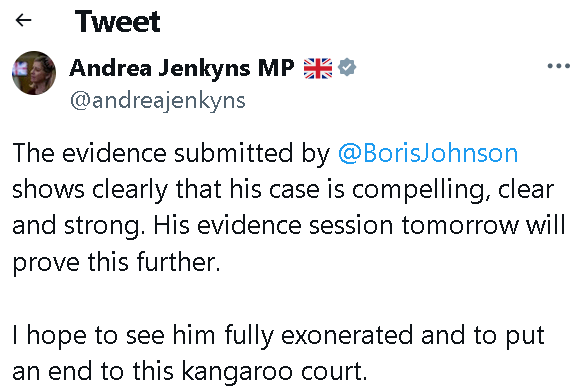
4 Jul 2023: Jacob Rees-Mogg and the other MPs “named” by the Privileges Committee are being called The Magnificent Seven. Dame Andrea Jenkyns was included because her tweet called it “a kangaroo court”. Her tweet on 21 Mar 2023 reads: “The evidence submitted by @BorisJohnson shows clearly that his case is compelling, clear and strong. His evidence session tomorrow will prove this further. I hope to see him fully exonerated and to put an end to this kangaroo court.”
Meanwhile, one of those on the Committee judging Boris Johnson, Bernard Jenkin, the chair of the House of Commons Liaison Committee, is being investigated by the police about possible breach of the Covid regulations in the Jingle and Mingle 8 Dec 2020 meeting in Downing Street. Boris Johnson has since then has also called it a kangaroo court and “a witch hunt”.
4 Dec 2024: Jacob Rees-Mogg also thinks that the Privileges Committee was a kangaroo court and that it claimed to know “what was inside Boris’ head” [at 20:49 hrs].
3 Feb 2025: Jacob Rees-Mogg: “it was all political and that disgraceful Privileges Committee hounded Boris out of office [at 20:36 hrs].
 Donald's Thoughts
Thank you HELEN
Sent from my iPhone
>
LikeLike
I sympathise with the defendant Mr.B. It’s the hallmark of a clandestine court when applying subjective evidence .
LikeLiked by 1 person