
A few years ago, on 1 Jan 2022 to be precise, I began a series of blogposts entitled Christian books and my Christian friends. However, it grew so long and complicated that I never found the opportunity to begin to publish it.
I have now decided that I can begin the same project with books that have been influential in my life and, in the process, I can integrate a potted biography of any significant persons associated with them.
It is a privilege to remember people associated with significant books, and more so with texts of Scripture. Preachers have this privilege when people remember particular sermons on specific texts of Scripture, and when these texts are read in one’s daily Bible reading, then these preachers come to mind. The same can be said about books.
I have read books from the whole spectrum of human life, but this series is primarily about Christian books. There may be little point in mentioning scientific or medical books, but significant events in these spheres, with their related books, may arise from time to time, such as when I was at Stornoway communion in August 1993 and I heard on the news that Fermat’s Last Theorem had been proven. I went immediately to buy a newspaper. The internet was not readily available in those days, although I was involved in setting up the first ecclesiastical website in Scotland at the time. However, these stories will need to wait their turn.
School books
This series is about books that have been influential in my life, in approximate chronological order so that I do not need to give priority to any book over another. School books are obviously early, but they were not influential in a religious manner. I noticed that the simplified paraphrase Bible for children was a dumbed-down version of “the real deal”. It did not prompt me to read the Bible. Some school books may be mentioned if they arise when dealing with other matters, such as my English-teacher Colin Black’s introducing me to Thinking with Concepts in my last year at school, and for the first time I began to enjoy English lessons. I discovered during his class discussions that I had an aptitude for ‘thinking with concepts’. Little did I know at the time how this would develop, for I was majoring on scientific subjects at school rather than linguistic and philosophical ones. This period coincided, I do not know why, or whether a book suggested it, with a daily early-morning cold bath! This experiment lasted for only one term of school and has never been repeated, although my new neighbours told me that they have a daily cold shower followed by a warm jacuzzi to encourage blood circulation.
Early authorship
I also began my scribal activities at school and after one summer holiday I showed my schoolfriends The Rules of Shove-Halfpenny which I had composed during my family’s one-month summer vacation in Harris. This was to ensure that rainy break-times, when we could not play football in the school playground would be suitably employed indoors on tabletops or desktops under the direction of regular and agreed rules. Regular competitors, such as Kenneth Caldwell, have never crossed my path since I left school, but I met Norman (“Nat” N. A. T.) Fyfe at a rare school reunion some years ago. Another scribal composition, along with my brother Andrew, was a map of Harris with its rivers and lochs to assist our orientation as we roamed its hills during these annual family holidays. One day Andrew caused alarm when he had not returned by late afternoon. He had twisted his ankle many miles away on the hills above sandy Luskentyre on the west of the island. There were no mobile phones in these days.
We holidayed with my mother’s sister Joan and her postman husband Roddy on the rocky east side of the island at 4 Kendebig on The Golden Road just before Miavaig. Our domestic search-party headed off into the hills, where my aunt’s cows roamed daily after we led them up the road each morning, through the cattle grid.
Presumably they were relieved to escape our twisting their tails to keep them in the move, while suited armed with a sturdy stick to prod them and protect us as children from any unwelcome bovine reaction. In retrospect, I admire their patience, but we were probably less irritating than the flies that their tails kept swiping away from their derrière, awaiting the next cow pat to land on the road.
Eventually Andrew was sighted limping over the hills, and the cows were collected at the same time from their waiting at the cattle grid. They were housed in the byre, where my uncles Roddy and Donald took turns each night to muck out the byre and then milk them. In the morning they were milked by auntie Joan, or ‘Shonag’ as she was known in the Gaelic, or ‘Da Joan’ by her namesake, my younger sister Joan. I can still hear the thud of her milk churn as she beat some of the milk into butter and crowdie. This was an easier task for us as children to do, than trying our hand at milking a cow, an art perfected only with practice. Possibly my Harris holidays merit a series of their own.
I do not post new blogposts on the Christian Sabbath. My Sabbath is full with biblical exegesis which feeds my soul throughout the Lord’s Day, whereas composing a blogpost takes up too much unnecessary time on the Sabbath. However, the work for this blogpost has already been done, and looking a significant day on which to launch this new and significant series, I reserved and scheduled it to post automatically today on yet another personal milestone – my 71st birthday today.
So where do I begin? At the beginning.
The Christian Bible
I am a man of one book, more than any other. I have read countless books, but in my teenage years, when I came under spiritual concern for my soul, I determined to know one book more than any other. This book is the Christian Bible, the inspired God-given record of the Person, mission, life and work of the Son of God in human nature, the Lord Jesus Christ, Whom to know is “eternal life” and Who gives meaning and purpose to my life, and Who can do the same for you.
“We know that the Son of God is come, and has given us an understanding, that we may know Him that is true, and we are in Him that is true, even in His Son Jesus Christ. This is the true God, and eternal life.”
1John 5:20
The Lord Jesus Christ is not only the love of my life but He is the Lord of my life, guiding me day by day as my Lord and my God.
Jesus is even now ruling from His throne in heaven Ps 110:1 over all things for His church Eph 1:20-23. He is overseeing the progress of His kingdom throughout the nations of the world, and I have access to Him by prayer any time I wish Heb 4:14-16 and Heb 10:19-22.
The apostle John wrote: “These things have I written unto you that believe on the name of the Son of God, in order that you may know that you have eternal life, and that you may believe on the name of the Son of God.”
1John 5:13
Thus I determined that the Christian Bible would be the one book that I would know better than any other. I have spent a lifetime in its study and I have composed my personal Bible commentary. I feed upon the Bible every day and obtain new matter Mat 13:52 for my soul in communion with my Lord and Saviour. The Son of God reveals God the Father to me by the guidance and teaching of the Holy Spirit. This satisfies my soul more than any other experiences in the world, and it is a daily blessing.
How did it begin?
As a young teenager, one Sabbath afternoon, in a moment of boredom, I pulled my Bible off its shelf and opened it at random to read it. It opened somewhere in the Book of Revelation and I read from this point onwards to the end of the Book. It was interesting but puzzling. Obviously I could not understand its details but the overall impression created in my mind was that there is a great battle in the Earth between the forces of good and the forces of evil. It looks as if evil is going to win, but in the end it is good that wins. It should be useful for people to realise that justice will catch up on their wickedness; it is the end of the matter that counts 1K 20:11. Recently a fellow Christian said to me that reading the Book of Revelation on one’s own could only lead to confusion without someone to explain it. Truly, this was the Ethiopian Eunuch’s experience reading Isa 53:7-8 but my experience contradicts such an opinion about the Book of Revelation because I picked up the gist of the Book although I think I had never read the Book of Revelation before.
The result was that this led to my reading the whole Bible from the beginning to the end and I have not stopped reading it ever since. Beginning at Genesis took me a year or more to reach Revelation at the end of the Bible, and by then I knew that the Bible would be my lifelong study. I quite liked the thought that it would take so long to reach the Book of Revelation again, because its message was disturbing, as it is meant to be, but the second time around was not so disturbing because 1. I knew what to expect and 2. by the second time I had read the whole biblical corpus with which to interact with the Book of Revelation.
I was not yet converted; I did not even know the Gospel. Although I had attended the Church of Scotland each Sabbath morning with my parents, I did not know the way to heaven nor how to avoid hell, for I did not know much about either place and gave no thought to them. So the Bible was my textbook on things religious.
My Harris holidays showed me that there was better preaching than I was hearing in my local Church of Scotland, so in my late teens I began to attend my mother’s native church, the Free Presbyterian Church of Scotland where I heard the Gospel preached for the first time from my father-in-Christ 1Cor 4:15, the Rev. Donald MacLean, a master preacher who majored on the majors, through whose voracious reading I learned subjects that I have heard no other preacher cover so thoroughly. His emphasis on “the Word and Spirit”, like Hugh Martin‘s The Abiding Presence, helped my Bible study. Some years later, the preaching and Christian fellowship of the Rev. Dr. John M. Brentnall developed my Bible study more thoroughly. The Bible became supremely important and after more than 50 years of reading, discussion and debate, I assert that if people cannot argue their case from Scripture then they need to learn to do so. The whole purpose of reading other books about Christianity should be so that you can understand the Bible better and how it applies to yourself and others. This is the only authoritative source about Jesus, His Person, office, character and teaching.
Rather than study the Bible, thousands of academics study theologians, history, and other disciplines, and finding faults of one kind or another, their scepticism increases. These academics impress the gullible with their learning and undermine the faith of multitudes 2Tim 2:18. This shows the importance of being grounded in the Scripture Col 1:23. It also explains these accounts of “evangelical turned atheist”, “evangelical turned Romanist”. Such changes do not arise from biblical exegesis but usually by some other means. Conversions in the opposite direction, towards Christ and Christianity, are almost always biblically-based. Muslim conversions to Christianity may not begin by Bible-reading but usually some extraordinary providence begins the process and leads them to the Bible.
Thankfully, the Lord led me in His providence to Jesus Christ and to the Bible in my teenage years. Everything and everyone claiming to be Christian has been tested by this infallible touchstone. Jesus’ radical teaching taught me critical thinking and enabled me to test claims to Christianity, church tradition and spirituality. He warned me against false Christianity and thereby He taught me self-examination.
The apostle Peter told us to make use of the Bible as our guide in things Christian, not an imaginary and usurping college of Roman Catholic cardinals.
The Mother’s Catechism
Strictly speaking, The Mother’s Catechism by John Willison should be included as an earlier influential book, not in a spiritual sense but in a biblically factual sense. I am amazed that so few people know about it. It is very good for children with its Yes/No responses and it has a section on biblical facts at the end. I discover many Christians who do not know these basic facts.
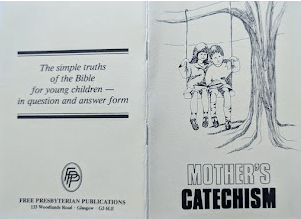
Before I was 10-years-old, I learned that Methuselah was the oldest man who lived on earth. He died aged 969 years, and there is even now a Methuselah Foundation and a Methuselah Project to attempt to increase mankind’s longevity. I was intrigued when British Telecom allocated to me for the Scottish Christian Party the telephone number 796952, which I split into 7-969-52 – seven days of the week, 52 weeks of the year, for the life of the longest man. This seems an appropriate way to describe the role of Christianity in public life.
The most intriguing answer in this Catechims for me as a youngster was: Why behoved our Redeemer to be both God and man? – the answer is: “He was man to die for us, and God to overcome death.” I could vaguely understand it but not fully till I was much older.
It was my mother, the first love in my life, who introduced me and my three siblings to The Mother’s Catechism, from which she quizzed us each Sabbath afternoon until we knew it perfectly, such was the competition between us. Possibly she got it from her elder brother, John Angus MacLeod, an elder in the Glasgow Free Presbyterian congregation.
The catechism was republished by the Free Presbyterian Church of Scotland. It included a short Grace Before Meat and Grace After Meat, which I learned and used for years until I began to pray for myself in public. It replaced the grace before meat that my father used, “For what we are about to receive, may the Lord make us truly thankful, for Christ’s sake. Amen.” It had other useful additions, which have not been reproduced in the 1994 reprint that I have. It is still in print by Free Presbyterian Publications and it is available from the Free Presbyterian Bookroom.
My mother tried to teach us the Westminster Shorter Catechism but we never got beyond Question 4 of the 107 Questions and Answers, so this would not become influential till several years later, which I will explain in due course, God willing.
This is enough material for one blogpost and the remainder of this series will post in due course. I plan to add chronological links here as new posts in the series are made, D.V.
Links:
17 Jun 2017: Biblical mnemonics.
17 Mar 2026: number 2 in this series.
 Donald's Thoughts