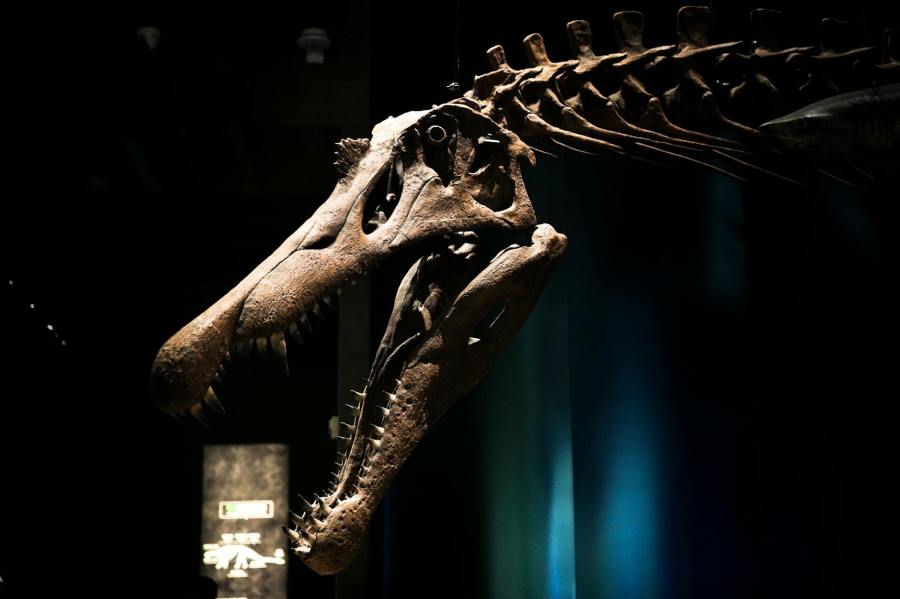
Fossils do not preserve the whole creature because only bones survive long enough to be fossilized.
In other words, the soft tissues such as muscles and skin perish with time.
Or so it was thought.
However, archaeologists are now discovering soft tissues preserved in fossils.
In 2007 a dinosaur mummy was discovered which had fossilized skin and soft tissues. Named Dakota, it is pictured here and reported in National Geographic magazine.
Red Blood Cells and collagen have been found in dinosaur bones.
This should change people’s thinking about the timescale of events in this world.
Examples:
Here is an account of the fossilized skin of a baby dinosaur in the BBC documentary Attenborough and the Giant Dinosaur, which shows “baby dinosaur skin”. The dinosaur eggs begin at 13:20 minutes and the skin at 16:17 minutes.
Here is a second example: “we have the preservation of the skin of an Ichthyosaur” at the beginning of Attenborough and the Sea Dragon at 1:35 minutes.
The skin and the collagen are made of protein which should degrade very rapidly; so how can they survive in dinosaur bones for millions of years?
They don’t. Dinosaurs are not as old as they are often declared to be.
It is causing difficulties among the evolutionists, as discussed in this BBC In Our Time broadcast on Feathered Dinosaurs at 43’00. “The survival of organic matter. People report DNA, Red Blood Cells, all kinds of extraordinary organic survival in fossils. What is the current position? If you find DNA in a young fossil like a woolly mammoth about 100,000 years old, people are not going to have a problem with that. But DNA and other biomolecules, proteins, tissues like feathers, which are made of the protein keratin, are very decay-prone and are not going to hang around over millions of years on geological timescales. So claims that these kind of biomolecules can survive are very, very controversial.” In other words, some people are trying to explain it away by suggesting that these are not real artefacts.
Here is one of the world’s top synthetic chemists Professor James Tour drawing attention to this problem.
Here are other examples from 2012 Nature magazine and in a 2015 BBC report.
The question is how do the skin and red blood cells survive long enough in order for them to be fossilised? This is not addressed in most videos.
Becoming a fossil
A beast does not become a fossil just because it died. More likely it will be scavenged. A beast needs to be buried rapidly, and so fossils are found in sedimentary rock, sometimes with food still in its stomach.
How do you bury huge graveyards of large dinosaurs or mammoths rapidly? There is a growing readiness to explain these fossil graveyards in terms of local floods. This is a start, but it does not go far enough. It requires a large flood. Nor do these happen every season. Local floods do not explain everything. Welcome, the global flood of Noah. Why are secular scientists so averse to considering a global flood? The ancient Sumerian epic of Gilgamesh with its global flood is regularly quoted by Assyriologists but not Noah’s flood. Could prejudice be at work?
The usual geological timescales need to be re-examined.

